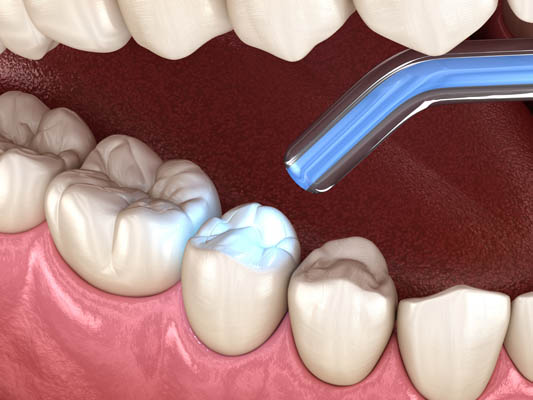
Dental fillings play a vital role in treating tooth decay. If tooth decay has progressed beyond its earliest stage, a filling will help restore the tooth to its former, healthy state.
The causes of tooth decay
Tooth decay is damage caused by bacteria, which, when combined with food, causes plaque. Over time, the bacteria in the plaque form acids, which start to eat away at your tooth. There are a few things that accelerate this process:
- Eating an abundance of sugary foods
- Not practicing good dental hygiene at home
- Not visiting the dentist for regular checkups
How to prevent tooth decay
To prevent tooth decay from ever starting, brush regularly with fluoride toothpaste, floss daily, eat healthy foods, visit the dentist regularly, and follow any specific directions he may provide.
If prevention steps are not followed and decay continues, it will progress through five stages. First, the tooth starts to lose minerals due to plaque build-up, creating a white spot. Next, enamel begins to decay, which usually produces a small brown spot. Things start to speed up after the second stage.
During the third stage, dentin decay occurs. Dentin lies underneath the enamel, and, at this point, significant sensitivity or pain may begin. The fourth and fifth stages are the most advanced stages of tooth decay. The decay starts to enter the pulp, which contains blood vessels and nerves. Lastly, bacteria can grow and cause a dangerous and severely painful abscess if the decay isn't addressed.
If the decay is caught during the first stage, a filling is sometimes not required. The condition will usually begin to reverse itself with good dental hygiene and a fluoride treatment or sealant. However, if the demineralized spot is not addressed, the decay will advance to stages two and three. During these stages, a dental filling is the primary treatment option for tooth decay. (Side note: Stages four and five typically require a more invasive procedure.)
The dental filling procedure
When a patient comes in for a dental filling, the dentist begins by removing all the decay from the tooth. After he's finished preparing the tooth, he will insert the filling. Fillings are usually made of porcelain, dental amalgam, composite resins, or other medically safe material. The patient will not feel any pain, as the dentist numbs the area before beginning the procedure.
Getting a filling usually takes 15 minutes to one hour, depending on the size and location of the cavity. Tooth sensitivity usually subsides within a day, and the tooth is restored to normal.
The bottom line in dental fillings
The main goal of a dental filling is to ensure more damage is not done to the tooth. The filling, or restoration, is sometimes necessary to prevent tooth decay from progressing. If decay is caught in the second or third stages, a dental filling is the main treatment option. After receiving the filling, the tooth will be restored to its healthy condition.
Request an appointment here: https://www.johnscreekteeth.com or call Johns Creek Dentistry at (770) 623-1427 for an appointment in our Johns Creek office.
Check out what others are saying about our dental services on Yelp: Composite Fillings in Johns Creek, GA.
Recent Posts
A new dental filling restores tooth structure, and smart aftercare helps it last. Understanding the importance of care and maintenance after you get a new filling can significantly improve your dental health and overall well-being. The following tips can help you maintain optimal oral hygiene to protect and extend the lifespan of your dental fillings. Patients…
Composite fillings, especially newer ones, are reasonably strong and durable, but they can wear out over time. Excess pressure, such as may occur when you grind your teeth, can cause them to wear out more quickly. Poor dental hygiene may contribute to decay that can compromise fillings. A filling that is loose is not a…
Composite fillings are resin materials made with a plastic and glass mixture. Dentists began to use tooth-colored fillings in the 1960s, but they were too weak for the back teeth. Nowadays, the composite resin is strong enough for all teeth. Dentists may use the fillings to restore a decayed tooth or reshape a disfigured, cracked,…
Dental patients with chipped or broken teeth have more options for tooth repair than in the past, such as the use of composite fillings. These fillings can not only restore a tooth but also prevent the need for extraction, which can leave gaps in the smile and cause the remaining teeth to shift. They can…